 Yesterday, we drank coffee and waited...
To pass the time, you'll recall, we muddled through an Edinburgh University study of former Fed chair Alan Greenspan's confidence level and whether it could be used to forecast movements in the gold price. Now we know the answer to a slightly different question. The lack of confidence others have in current Fed chair Ben Bernanke's statements can certainly move the gold price... and the price of everything else, too. Down. "Pick your poison," chimed in The Rude Awakening's Greg Guenthner this morning. "Bonds. Stocks. Emerging markets. Commodities. Wherever you decide to turn this morning, you'll see red on your screen." No kidding...  Crimson Shades of '08 Ouch. Where does all that money go? "Money heaven..." Dave Gonigam, our compatriot at The 5 Min. Forecast, suggests. What comes "out of thin air"... returns from whence it came. "American investors have taken out more margin loans than ever before," observes Floyd Norris in The New York Times. When the stock market hits consecutive highs, as it has for the past 6 months, individual investors pile in... and are willing to borrow money to speculate. "Speculative investing has grown among retail investors," Norris continues, "reaching levels that in the past indicated the market was getting to unsustainable levels and might be in for a fall." Floyd offers U.S. margin debt as a percentage of U.S. GDP as a guide: 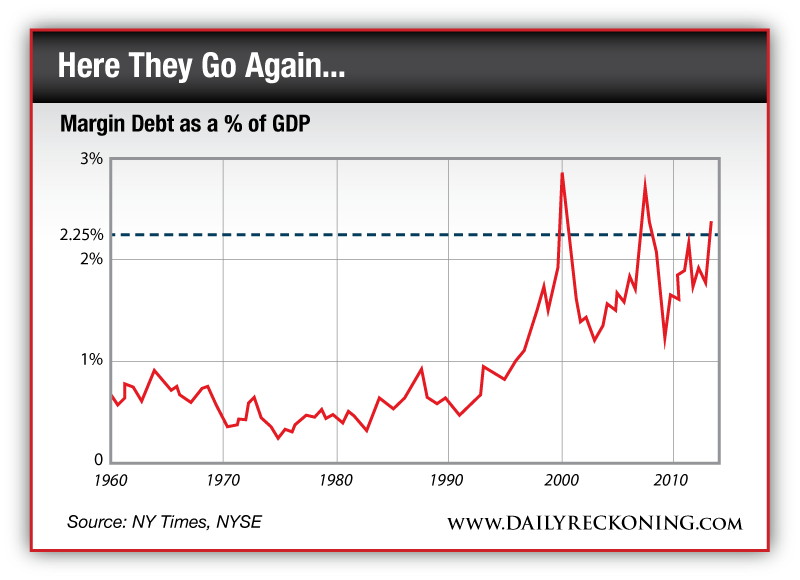 "The first time in recent decades that total margin debt exceeded 2.25% of GDP came at the end of 1999, amid the technology stock bubble. Margin debt fell after that bubble burst, but began to rise again during the housing boom -- when anecdotal evidence said some investors were using their investments to secure loans that went for down payments on homes. "That boom in margin loans also ended badly." Will this time end badly? We don't know... but we're willing to hazard a guess. "The rising level of debt is seen as a measure of investor confidence," says Alexandra Scaggs in today's Wall Street Journal, "as investors are more willing to take out debt against investments when shares are rising and they have more value in their portfolios to borrow against. "The latest rise has been fueled by low interest rates and a 16% year-to-date stock market rally." 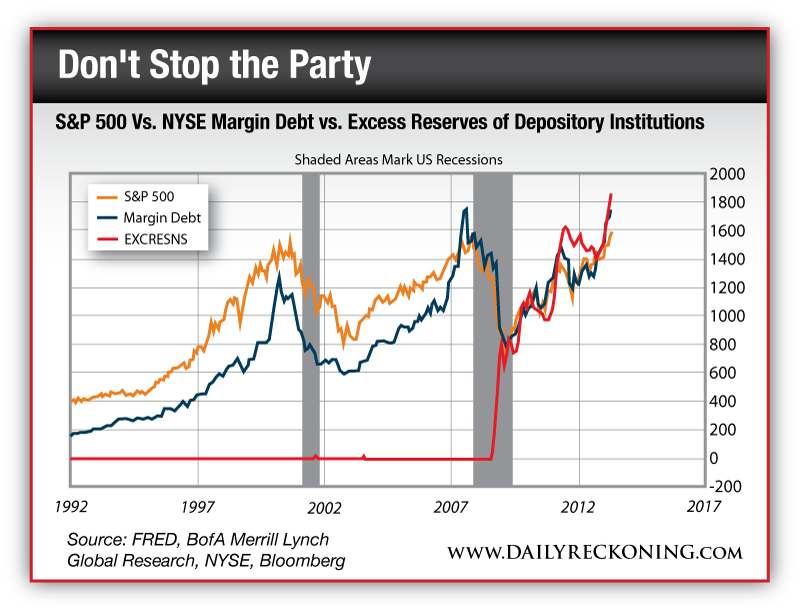 Summary: The Fed pumps hot money into the banking system. Excess reserves beget margin loans. Margin loans, by definition, fuel speculation. Then, poof. "In my opinion," writes one contemplative reader following our investment thesis with some skepticism, "trying to use gold, tulips or any substance to control bankers and politicians is a cop-out. It's like using burqas in Islam to prevent men from getting bothered by attractive women... [these speculative rallies] are part of our nature." Indeed, the easy money works great... until it doesn't work anymore. "I am sure politicians," the reader goes on, "if really interested in devaluing the dollar with gold as a backup could figure a way to manipulate the price of gold for their own use. Isn't this what politicians do best?" Perhaps they ought to try it. Just a little... Alas, devaluing the dollar, sans gold, is part and parcel of the Fed's currency war against other deflating fiat currencies. James Rickards, author of Currency Wars and today's guest essay for The Daily Reckoning, knows all too well. In today's episode, Mr. Rickards shows how you're stuck in the middle of the Fed's tug-of-war match with the forces of deflation... [Ed. Note. Mr. Rickards will be joining us as a speaker at this year's Investment Symposium at the Fairmont Hotel in Vancouver, British Columbia, July 23-26, 2013. There are fewer than 200 seats left. If you'd like to attend, hurry up and reserve yours, here.] |
||
Thursday, June 20, 2013
Addison Wiggin contemplating the market's reaction to the Fed (after a long nap)...

Friday, May 24, 2013
Android's Biggest Security Threat: OS Fragmentation
- Mar 08, 2013 11:11 AM EST

The latest data from Google shows that 44 percent of Android users are still on "Gingerbread," or versions 2.3.3 through 2.3.7, which was released two years ago. Gingerbread has a number of security vulnerabilities which have been fixed in later versions. The OS breakdown data is based on statistics collected from Android devices connecting to Google Play from Feb. 22 to March 4.
Just 16 percent of Android devices are running version 4.1 or 4.2 of the mobile operating system, according to Google. Also known as "Jelly Bean," the latest Android version was released six months ago, but a majority of Android users have not been able to upgrade to the new OS because the process is tightly controlled by the carriers.
"The problem with Android is that most people have old versions on their phone," Collin Mulliner, a postdoctoral researcher with the SECLAB at Northeastern University in Boston, said during a mobile security panel discussion at last month's RSA Conference.
At our SecurityWatch Summit last fall, Dan Guido, CEO and co-founder of Trail of Bits, noted that the majority of iOS devices are updated within weeks, it not days, of Apple releasing the new operating system.
Mobile Carriers Lag on Updates
"One of the most important things in software security today is the ability to remotely update," Mulliner said on the panel. While users can initiate the operating system update on their own for iPhones and iPads, Android, mobile carriers control the entire process for Android devices. At the moment, their collective record for pushing out updates for users is absolutely dismal.
The problem is that Android's open platform allows device manufacturers and carriers to tweak the operating system to bundle extra software and set certain configuration settings. Whenever Google releases an operating system update, both the vendor and carriers have to test the changes against their homebrew systems before rolling out the latest version. The carriers claim this is a slow process, but many security experts believe carriers are prioritizing profit over security.
Some phones just don't get the latest Android update because they are being phased out or are older models, Chris Soghoian, a privacy researcher and activist, said at a different event earlier this year. Manufacturers focus their efforts on devices currently for sale and coming to the market, and wireless carriers "only care about you once every two years" when the user contract is up for renewal, Soghoian said. For example, an LG Android smartphone didn't get its first OS update for 16 months, and many phones never even get that first update, let alone a second one.
Considering that Google has pushed out a new version approximately every six months, it's easy to see how quickly users can become out-of-date.
A drive-by attack, where the user is compromised just by visiting a malicious site, is not the biggest threat facing Android users, Charlie Miller, a researcher well-known for his work on iOS and Android security, said during the same panel at the RSA Conference.
"People think that drive-by is a big threat, but in real life they just don't happen," Miller said. When it comes to Android, the biggest risk facing users is the fact that their devices are running outdated and un-patched versions of the operating system, he said. The latest versions of Android have security patches and improved exploit mitigations.
Cyber-criminals know users are running vulnerable operating systems. All criminals have to do is release a malicious app exploiting a vulnerability in an old version of Android, and hit a significant chunk of the user base.
As Soghoian pointed out earlier, "You don't need a zero-day to attack most Android devices if consumers are running 13-month-old software."
Unfortunately, this situation is not likely to change unless carriers start taking security seriously, or Google wrests control of the update process away from the carriers. The most secure Android device around is the Nexus 4 smartphone from Google, as the company has full control over the updates.
Wednesday, May 22, 2013
The Hidden Deficiency Zapping Your Energy and Brainpower
Did You Know...
... that olive oil infused with ozone is a remarkable anti-bacterial ointment that not only heals serious skin disorders, but also beautifies and hydrates your skin?
 What do penicillin, cookies, and popsicles have in common? They were all discovered accidentally, as were ozonated oils, all-natural ointments that heal everything from cellulite to insect bites.
In the 1900s, doctors administering tuberculosis treatments found that when ozone is repeatedly breathed through oil, it converts the oil into ozone-infused gels. Ozonated oils evolved into a popular healing therapy until the mid-1900s, when pharmaceutical companies launched a campaign against natural medicines. All it took was some strong-arming from the FDA, and ozonated oils disappeared from doctors' shelves.
More than 60 years later, ozonated oils are making a comeback. Doctors in over 20 countries depend on the healing properties of these gels to help accelerate postoperative recovery. Ozonated oils boost blood flow, reduce inflammation and alleviate pain after surgery.
Ozonated oils are used to treat:
Ozonated Olive Oil
Olive oil ranks as the most popular ozonated oil on the market. Manufacturers start with pure, organic, cold-pressed, extra-virgin olive oil. Ozone is a highly reactive gas, but when passed through the oil for an extended period of time, the gas becomes more and more stable, and the oil transforms into a paste, or gel. Processing equipment, however, varies.
If olive oil is ozonated in a cheap coronal discharge generator it becomes vulnerable to contamination. Make sure the ozonated oil you purchase has been converted in a cold plasma oil generator for purity and potency.
Paste or Oil?
Made with no artificial chemicals, ozonated paste has greater healing properties than ozonated liquid does. The difference lies in the amount of saturated oxygen and ozone they contain. Ozonated olive oil paste is the winner, with a 50% concentration compared to the 10% concentration found in ozonated olive oil liquid. Ozonated paste also has a built-in, time-release formula, protecting skin for more than 12 hours after application.
Ozonated olive oil can last up to 10 years when refrigerated, and a good year when stored at room temperature. The ultimate anti-bacterial salve, it destroys harmful bacteria, viruses, parasites, fungi, venom and poisons with no adverse side effects. Plus, ozonated olive oil is an antibiotic that does not stop working. That's because since toxins and pathogens do not become resistant, it's as effective on the thousandth treatment as it is on the first.
Applied topically, ozonated oil seeps into the skin, pushing toxins through the pores and out of the body. As it crosses the skin barrier, ozonated olive oil helps stimulate new cell production, thereby healing even the most chronic skin conditions while rejuvenating a healthy outer layer of skin.
Other Ozonated Oils
 Hemp,
avocado, coconut? The options for ozonated oils are steadily growing.
Ozonated jojoba oil is becoming increasingly popular, especially as a
skin cream. Because the chemical makeup of jojoba oil is remarkably
similar in composition to human sebum, ozonated jojoba helps deeply
hydrate and heal sensitive skins.
Hemp,
avocado, coconut? The options for ozonated oils are steadily growing.
Ozonated jojoba oil is becoming increasingly popular, especially as a
skin cream. Because the chemical makeup of jojoba oil is remarkably
similar in composition to human sebum, ozonated jojoba helps deeply
hydrate and heal sensitive skins.
Ozonated sunflower oil is also growing in popularity due to its availability and cost-effectiveness. If you aren't a fan of the gel-like consistency of the pastes, then opt for ozonated sunflower oil, which converts to a viscous liquid when processed.
Whether or not you add ozonated oils to your skin care regimen, you may want to at least consider keeping some
 Unfortunately,
many of us are familiar with the hallmark signs of aging: declining
strength and energy, brain fog and "senior moments," irritability,
difficulty sleeping, hearing and vision loss...the list goes on. Most
people attribute these symptoms to "getting older," but the truth is
that none of these problems are actually related to normal, healthy
aging.
Unfortunately,
many of us are familiar with the hallmark signs of aging: declining
strength and energy, brain fog and "senior moments," irritability,
difficulty sleeping, hearing and vision loss...the list goes on. Most
people attribute these symptoms to "getting older," but the truth is
that none of these problems are actually related to normal, healthy
aging.
More often than not, there's an easily remedied vitamin deficiency underlying many of these symptoms, making you feel older than you are! Yet tragically, this deficiency is rarely detected by doctors... until it manifests as a severe neurological disorder, dementia, mental illness, chronic fatigue, cardiovascular disease, cancer...or worse.
I'm referring to vitamin B12 deficiency, which sadly, affects nearly 50% of older adults. If you've experienced any of the symptoms described above, it's imperative that you take action before irreversible damage occurs. The good news is that B12 deficiency can be remedied easily, quickly and inexpensively. But it's crucial that you take the right kind of B12.
What You Need to Know About B12
Vitamin B12 is essential to the very foundation of life itself. It's one of the building blocks your body uses to produce DNA. It keeps your immune system functioning optimally, regulates mood and sleep cycles, and is crucial to energy production, which is why it's known as the "energy vitamin."
Vitamin B12 also protects your brain and nervous system by keeping nerves healthy and communicating in an optimal manner. And emerging research is showing that B12 helps to lower levels of the stress hormone homocysteine, making it a vital player in maintaining heart and brain health.
How B12 Protects Your Brain
Cognitive decline is a serious concern for most of us as we age. The statistics are grim: If you live to be 80, your chances of suffering from severe loss of cognitive function are 1 in 2. That means every other person will suffer measurable loss of brain function! The good news is that getting enough B12 can drastically cut your risk.
Scientists now understand that age-related cognitive decline is linked to a process in the body that involves a decrease in brain mass. Your brain actually shrinks as you age. This reduction in brain mass is directly correlated with loss of memory and cognitive function.
Emerging research shows that B12 deficiency puts your brain in serious danger. Recently, a landmark study showed vitamin B12 supplementation slows the accelerated rate of brain shrinkage and declining cognitive scores in older individuals. Another study showed that older individuals with higher levels of B12 in their blood had less shrinkage of the brain than counterparts with lower levels. Those with higher B12 blood levels and increased brain size even scored higher on memory and cognitive tests.
B12 Deficiency: The Silent Epidemic
 Recent studies have shown that nearly 1 in 2 older adults have dangerously low levels of B12.
The older you are, the higher your risk, but younger people aren't
exempt from harm. In a shocking recent Tufts University study,
researchers found that nearly 1 in 4 people over age 26 are at least
borderline deficient in B12 and may already be experiencing symptoms as a
result.
Recent studies have shown that nearly 1 in 2 older adults have dangerously low levels of B12.
The older you are, the higher your risk, but younger people aren't
exempt from harm. In a shocking recent Tufts University study,
researchers found that nearly 1 in 4 people over age 26 are at least
borderline deficient in B12 and may already be experiencing symptoms as a
result.
The worst part is that doctors typically misdiagnose B12 deficiency symptoms. They then prescribe drugs that do nothing to address the problem, but instead, have plenty of destructive side effects. You can and must avoid falling into that trap.
Why Are So Many People B12 Deficient?
The reason that the vast majority of people end up B12 deficient has nothing to do with their B12 intake, but rather, their ability to absorb B12 from food.
Over the years, the lining of your stomach gradually loses its ability to produce hydrochloric acid, which you need to absorb B12 from food. The use of certain drugs can also lower your stomach acid secretion, further hampering B12 absorption. This is why with B12 supplements, a sublingual (under the tongue) delivery system—which ensures the B12 goes directly into your bloodstream, bypassing your digestive tract—is absolutely essential.
WARNING: Some B12 Supplements Contain Cyanide
The form of B12 that you'll find in most B12 products is cyanocobalamin, which is comprised of a cyanide molecule attached to a cobalamin (B12) molecule. Cyanide is a toxic poison that the body cannot metabolize, and over time, it can accumulate in brain tissues with disastrous results.
Far too many B12 supplements on the market today are made with this virtually worthless form of B12. This is a classic example of companies cutting corners to save money at the expense of your health, which is truly a shame.
What Makes a Safe, Effective, and Powerful B12 Supplement?
 First, you must have the right form of B12. Research has shown the safest and most effective form of B12 to be methylcobalamin.
Second, you need the methylcobalamin form of B12 in the right delivery system. Insist on a sublingual (under the tongue) delivery system instead of a pill. Sublingual delivery ensures absorption directly into the bloodstream, bypassing the digestive tract, which makes it effective even for those who can't absorb B12 from food. With a sublingual B12, you'll experience immediate boosts in your energy, mental clarity and mood.
Third, you need the right dosage. Most experts recommend 1,000 mcg a day of sublingual methylcobalamin. Up to 15,000 mcg per day is sometimes required to bring levels back up to an optimal level and to restore energy, mental function, and mood balance. B12 has no known drug interactions and has never shown any adverse or toxic effects in humans, even when given in very large doses.
Finally, you must ensure that your B12 formula is made in the USA in an FDA inspected facility using only 100% pure methylcobalamin, the form of B12 that has been shown in research studies to be the safest and most effective form for everyday use.
Feel the Difference in 1 to 3 Days
Virtually no B12 supplements on the market meet these requirements, except for one! Joshua Corn, the highly regarded creator of the Live in the Now natural health newsletter and owner of Stop Aging Now, has been formulating premium-grade dietary supplements for over 15 years. Working with the Stop Aging Now Scientific Advisory Board he created a convenient vitamin B12 formula that is simply superior to anything else out there, and it has become one of Stop Aging Now's best-selling products. But this superior B12 is not available in stores.
Click here to discover the B12 formula that delivers on all these counts and more. Within 1 to 3 days you'll experience... more energy throughout the day... enhanced cognitive function... fewer "senior moments"... more balanced moods... deeper, more restful sleep... better digestion... and stronger immune system. You don't have to be a statistic. Click here and protect yourself and your loved ones right now.
If the links above aren't working, just copy & paste the following
website address onto your Internet browser:
http://www.stopagingnow.com/energy129
... that olive oil infused with ozone is a remarkable anti-bacterial ointment that not only heals serious skin disorders, but also beautifies and hydrates your skin?
What do penicillin, cookies, and popsicles have in common? They were all discovered accidentally, as were ozonated oils, all-natural ointments that heal everything from cellulite to insect bites.
In the 1900s, doctors administering tuberculosis treatments found that when ozone is repeatedly breathed through oil, it converts the oil into ozone-infused gels. Ozonated oils evolved into a popular healing therapy until the mid-1900s, when pharmaceutical companies launched a campaign against natural medicines. All it took was some strong-arming from the FDA, and ozonated oils disappeared from doctors' shelves.
More than 60 years later, ozonated oils are making a comeback. Doctors in over 20 countries depend on the healing properties of these gels to help accelerate postoperative recovery. Ozonated oils boost blood flow, reduce inflammation and alleviate pain after surgery.
Ozonated oils are used to treat:
|
• Acne • Eczema • Psoriasis • Diaper Rash • Insect/Spider Bites • Wrinkles • Athlete's Foot • Cuts/Wounds/Bed Sores • Bacterial Infections |
• Ring Worm • Herpes Simplex • Shingles • Burns/Sunburns • Impetigo • Gingivitis • Age Spots • Hemorrhoids • And much, much more! |
Ozonated Olive Oil
Olive oil ranks as the most popular ozonated oil on the market. Manufacturers start with pure, organic, cold-pressed, extra-virgin olive oil. Ozone is a highly reactive gas, but when passed through the oil for an extended period of time, the gas becomes more and more stable, and the oil transforms into a paste, or gel. Processing equipment, however, varies.
If olive oil is ozonated in a cheap coronal discharge generator it becomes vulnerable to contamination. Make sure the ozonated oil you purchase has been converted in a cold plasma oil generator for purity and potency.
Paste or Oil?
Made with no artificial chemicals, ozonated paste has greater healing properties than ozonated liquid does. The difference lies in the amount of saturated oxygen and ozone they contain. Ozonated olive oil paste is the winner, with a 50% concentration compared to the 10% concentration found in ozonated olive oil liquid. Ozonated paste also has a built-in, time-release formula, protecting skin for more than 12 hours after application.
Ozonated olive oil can last up to 10 years when refrigerated, and a good year when stored at room temperature. The ultimate anti-bacterial salve, it destroys harmful bacteria, viruses, parasites, fungi, venom and poisons with no adverse side effects. Plus, ozonated olive oil is an antibiotic that does not stop working. That's because since toxins and pathogens do not become resistant, it's as effective on the thousandth treatment as it is on the first.
Applied topically, ozonated oil seeps into the skin, pushing toxins through the pores and out of the body. As it crosses the skin barrier, ozonated olive oil helps stimulate new cell production, thereby healing even the most chronic skin conditions while rejuvenating a healthy outer layer of skin.
Other Ozonated Oils
Hemp,
avocado, coconut? The options for ozonated oils are steadily growing.
Ozonated jojoba oil is becoming increasingly popular, especially as a
skin cream. Because the chemical makeup of jojoba oil is remarkably
similar in composition to human sebum, ozonated jojoba helps deeply
hydrate and heal sensitive skins.
Ozonated sunflower oil is also growing in popularity due to its availability and cost-effectiveness. If you aren't a fan of the gel-like consistency of the pastes, then opt for ozonated sunflower oil, which converts to a viscous liquid when processed.
Whether or not you add ozonated oils to your skin care regimen, you may want to at least consider keeping some
= = = = = = = = = = =
Featured Article:
Featured Article:
The Hidden Deficiency Zapping
Your
Energy and Brainpower
Sadly, this affects 1 in 2 older adults. Are you one of them?
Energy and Brainpower
Sadly, this affects 1 in 2 older adults. Are you one of them?
Unfortunately,
many of us are familiar with the hallmark signs of aging: declining
strength and energy, brain fog and "senior moments," irritability,
difficulty sleeping, hearing and vision loss...the list goes on. Most
people attribute these symptoms to "getting older," but the truth is
that none of these problems are actually related to normal, healthy
aging.
More often than not, there's an easily remedied vitamin deficiency underlying many of these symptoms, making you feel older than you are! Yet tragically, this deficiency is rarely detected by doctors... until it manifests as a severe neurological disorder, dementia, mental illness, chronic fatigue, cardiovascular disease, cancer...or worse.
I'm referring to vitamin B12 deficiency, which sadly, affects nearly 50% of older adults. If you've experienced any of the symptoms described above, it's imperative that you take action before irreversible damage occurs. The good news is that B12 deficiency can be remedied easily, quickly and inexpensively. But it's crucial that you take the right kind of B12.
|
|
 Low energy and weakness Memory problems Confusion or "fuzziness" Irritability and mood swings Persistent sleep problems Low energy and weakness Memory problems Confusion or "fuzziness" Irritability and mood swings Persistent sleep problems |
Dizziness or lightheadedness Digestive problems Weak immunity Hearing and vision loss Tingling in the extremities |
What You Need to Know About B12
Vitamin B12 is essential to the very foundation of life itself. It's one of the building blocks your body uses to produce DNA. It keeps your immune system functioning optimally, regulates mood and sleep cycles, and is crucial to energy production, which is why it's known as the "energy vitamin."
Vitamin B12 also protects your brain and nervous system by keeping nerves healthy and communicating in an optimal manner. And emerging research is showing that B12 helps to lower levels of the stress hormone homocysteine, making it a vital player in maintaining heart and brain health.
How B12 Protects Your Brain
Cognitive decline is a serious concern for most of us as we age. The statistics are grim: If you live to be 80, your chances of suffering from severe loss of cognitive function are 1 in 2. That means every other person will suffer measurable loss of brain function! The good news is that getting enough B12 can drastically cut your risk.
Scientists now understand that age-related cognitive decline is linked to a process in the body that involves a decrease in brain mass. Your brain actually shrinks as you age. This reduction in brain mass is directly correlated with loss of memory and cognitive function.
Emerging research shows that B12 deficiency puts your brain in serious danger. Recently, a landmark study showed vitamin B12 supplementation slows the accelerated rate of brain shrinkage and declining cognitive scores in older individuals. Another study showed that older individuals with higher levels of B12 in their blood had less shrinkage of the brain than counterparts with lower levels. Those with higher B12 blood levels and increased brain size even scored higher on memory and cognitive tests.
B12 Deficiency: The Silent Epidemic
Recent studies have shown that nearly 1 in 2 older adults have dangerously low levels of B12.
The older you are, the higher your risk, but younger people aren't
exempt from harm. In a shocking recent Tufts University study,
researchers found that nearly 1 in 4 people over age 26 are at least
borderline deficient in B12 and may already be experiencing symptoms as a
result.
The worst part is that doctors typically misdiagnose B12 deficiency symptoms. They then prescribe drugs that do nothing to address the problem, but instead, have plenty of destructive side effects. You can and must avoid falling into that trap.
Why Are So Many People B12 Deficient?
The reason that the vast majority of people end up B12 deficient has nothing to do with their B12 intake, but rather, their ability to absorb B12 from food.
Over the years, the lining of your stomach gradually loses its ability to produce hydrochloric acid, which you need to absorb B12 from food. The use of certain drugs can also lower your stomach acid secretion, further hampering B12 absorption. This is why with B12 supplements, a sublingual (under the tongue) delivery system—which ensures the B12 goes directly into your bloodstream, bypassing your digestive tract—is absolutely essential.
|
Are at Higher Risk if You... → Are over the age of 45 → Take acid-blocking medications → Are a vegan or vegetarian → Are or have ever been anemic → Suffer from digestive problems → Have low stomach acid → Take certain diabetes drugs → Drink alcoholic beverages |
WARNING: Some B12 Supplements Contain Cyanide
The form of B12 that you'll find in most B12 products is cyanocobalamin, which is comprised of a cyanide molecule attached to a cobalamin (B12) molecule. Cyanide is a toxic poison that the body cannot metabolize, and over time, it can accumulate in brain tissues with disastrous results.
Far too many B12 supplements on the market today are made with this virtually worthless form of B12. This is a classic example of companies cutting corners to save money at the expense of your health, which is truly a shame.
What Makes a Safe, Effective, and Powerful B12 Supplement?
First, you must have the right form of B12. Research has shown the safest and most effective form of B12 to be methylcobalamin.
Second, you need the methylcobalamin form of B12 in the right delivery system. Insist on a sublingual (under the tongue) delivery system instead of a pill. Sublingual delivery ensures absorption directly into the bloodstream, bypassing the digestive tract, which makes it effective even for those who can't absorb B12 from food. With a sublingual B12, you'll experience immediate boosts in your energy, mental clarity and mood.
Third, you need the right dosage. Most experts recommend 1,000 mcg a day of sublingual methylcobalamin. Up to 15,000 mcg per day is sometimes required to bring levels back up to an optimal level and to restore energy, mental function, and mood balance. B12 has no known drug interactions and has never shown any adverse or toxic effects in humans, even when given in very large doses.
Finally, you must ensure that your B12 formula is made in the USA in an FDA inspected facility using only 100% pure methylcobalamin, the form of B12 that has been shown in research studies to be the safest and most effective form for everyday use.
Feel the Difference in 1 to 3 Days
Virtually no B12 supplements on the market meet these requirements, except for one! Joshua Corn, the highly regarded creator of the Live in the Now natural health newsletter and owner of Stop Aging Now, has been formulating premium-grade dietary supplements for over 15 years. Working with the Stop Aging Now Scientific Advisory Board he created a convenient vitamin B12 formula that is simply superior to anything else out there, and it has become one of Stop Aging Now's best-selling products. But this superior B12 is not available in stores.
Click here to discover the B12 formula that delivers on all these counts and more. Within 1 to 3 days you'll experience... more energy throughout the day... enhanced cognitive function... fewer "senior moments"... more balanced moods... deeper, more restful sleep... better digestion... and stronger immune system. You don't have to be a statistic. Click here and protect yourself and your loved ones right now.
website address onto your Internet browser:
http://www.stopagingnow.com/energy129
Thursday, May 16, 2013
Sign the letter urging President Obama to reject Keystone XL
| Tell Rep. Markey: Sign the letter urging President Obama to reject Keystone XL | ||||
| The petition to Rep. Markey reads: The Keystone XL pipeline is not in our national interest. Please co-sign Rep. Grijalva's letter urging President Obama to reject Keystone XL.
Automatically add your name:
| ||||
Republicans in the House are gearing up for yet another symbolic vote to force approval of Keystone XL. Of course, Keystone XL is President Obama’s decision – not the climate deniers who make up a majority of our Congress – but we know that he is sensitive to pressure from Congress as he considers his decision. Now we have an important opportunity to build pressure on the President from those in Congress who actually accept science. Arizona Rep. Raul Grijalva has just written a great letter asking President Obama to reject Keystone XL. (Full text below.) The more representatives we can get to add their names before it gets sent to the President, the more pressure the president will feel. Tell your member of Congress, Rep. Markey, to co-sign the Grijalva letter urging President Obama to reject Keystone XL. Click here to automatically sign the petition. President Obama recognizes that a majority in Congress deny the science of climate change. His Organizing for Action has made calling out climate denial a major focus of its messaging. But calling out climate denial is not enough – President Obama needs to show that he is committed to action. The first, easiest thing he can do is reject Keystone XL. The President’s efforts to call out members of congress for ignoring scientists will be meaningless if his own administration does the very same thing -- deny the scientists who are unequivocally clear on the need to keep carbon in the ground – when it comes to his decision on the Keystone XL pipeline. If enough Representatives sign Rep. Grijalva’s letter, it could make a big impression on the president. But for that to happen, Rep. Markey needs to hear from you. Click here to automatically sign the petition: http://act.credoaction.com/go/546?t=4&akid=7939.4923402.rDsc85 Thanks for fighting Keystone XL. Elijah Zarlin, Campaign Manager CREDO Action from Working Assets
Automatically add your name:
Dear President Obama, We stand with millions of Americans concerned about the strength of our economy, gas prices, and the safety of our water supply in urging you to reject the Keystone XL pipeline. When you strip away the rhetoric, the facts are clear: Keystone XL will export Canadian oil through our country – not to our country. As an export pipeline, Keystone XL does not reduce our dependence on foreign oil. It does not protect American families from increasing gas prices or price spikes on the global market. The history of tar sands pipelines is full of failed promises, difficult cleanups and environmental damage. Tar sands crude is both more toxic and more difficult to clean up than conventional oil. A 2010 spill involving tar sands crude on the Kalamazoo River has still not been remedied. The climate impacts are perhaps even greater than the immediate damage to water sources, and will be felt by every American for decades to come. The State Department’s conclusion that we might as well approve Keystone XL because the tar sands will inevitably be burned is not only untrue, it is a stunning breach of our national security. Secretary of Defense Leon Panetta is hardly alone in the military community in declaring that climate change “has a dramatic impact on national security.” Keystone XL will increase global demand for tar sands, which produce far more climate-heating emissions than conventional oil. There is a better way forward, and we call on you to continue leading the way. The only way to reduce high gas prices is to use less fuel. We applaud your administration’s historic efforts to increase vehicle fuel efficiency, your investments in sustainable technologies, and your inspiring call in the State of the Union Address to fund research to move our vehicles away from oil altogether. Rejecting Keystone XL should be another part of your positive environmental legacy. Efforts already under way are saving Americans money at the pump and creating new engineering and manufacturing jobs. Approving Keystone would put many of these advances in jeopardy. It would mean a return to the dirty economy of the past rather than a step toward the clean economy of the future. The costs of approving Keystone XL far outweigh any benefits. The American people are depending on your leadership. This dirty pipeline is not in our national interest, and we urge you to reject it. Sincerely, Raúl M. Grijalva Member of Congress | ||||
|
||||
| © 2013 CREDO. All rights reserved. |


If it's good enough for the banks, it's good enough for students:Become a citizen co-sponsor of the Bank on Students Loan Fairness Act now
|
||||||||


|
|


Sunday, May 12, 2013
Breaking: Two Silicon Valley leaders quit FWD.us over support for Keystone XL
| The petition to FWD.us co-founders reads: "Repudiate FWD.us propaganda supporting Keystone XL and drilling in the Arctic Refuge by resigning from the organization immediately."
Automatically add your name:
| ||||
This is a direct result of a campaign by CREDO and our allies to stop Zuckerberg's group from praising conservative politicians for backing the Keystone XL pipeline and drilling in the Arctic National Wildlife Refuge in a dangerously misguided attempt to win support for immigration reform. It's time for other tech industry luminaries to make it clear where they stand. In addition to Facebook founder Mark Zuckerberg, LinkedIn’s Reid Hoffman, eBay’s John Donahoe, Yahoo’s Marissa Mayer and Kleiner Perkins’ John Doerr are co-founders of the group. Tell FWD.us co-founders: Repudiate FWD.us propaganda supporting Keystone XL and drilling in the Arctic Refuge by resigning from the organization. Click here to sign. Elon Musk, the founder of electric carmaker Tesla, explained his departure saying “I agreed to support Fwd.us because there is a genuine need to reform immigration. However, this should not be done at the expense of other important causes."2 The other Silicon Valley star that joined Musk in protesting the group's attack on key environmental priorities was David Sacks, the founder of Yammer. These technology leaders can't have it both ways. They can't be for clean energy and action on climate change and fund conservative propaganda that promotes the Keystone XL pipeline and drilling in the Arctic National Wildlife Refuge. Silicon Valley stars like LinkedIn’s Reid Hoffman, eBay’s John Donahoe, Yahoo’s Marissa Mayer, Kleiner Perkins’ John Doerr and even Facebook's Mark Zuckerberg are sensitive to public backlash from the people who power their social networks or use their products or services. If enough of us push back and keep this issue in the public eye, they will be under immense pressure, not just from us but from their staff and shareholders, to stop supporting FWD.us. Tell Facebook founder Mark Zuckerberg, LinkedIn’s Reid Hoffman, eBay’s John Donahoe, Yahoo’s Marissa Mayer and Kleiner Perkins’ John Doerr: Follow Elon Musk's example and resign from FWD.us. Click here to sign. The campaign against FWD.us, which includes efforts not just by CREDO but also our allies at Progressives United, 350.org, Sierra Club, League of Conservation Voters and other groups, has been covered extensively in the technology and political press with stories in the Washington Post, New York Times, San Jose Mercury News, Huffington Post and dozens of other outlets. Elon Musk's high profile departure from the group gives us new momentum to escalate our campaign and send a message to Silicon Valley political donors that if they throw Keystone XL under the bus, that we will hold them accountable. Please sign our petition and then share it with friends and family. We will deliver these signatures directly to Facebook founder Mark Zuckerberg, LinkedIn’s Reid Hoffman, eBay’s John Donahoe, Yahoo’s Marissa Mayer and Kleiner Perkins’ John Doerr. These tech leaders are not used to hearing directly from the public and in such large numbers. Your signature can make a real difference in this campaign. Tell FWD.us co-founders: Repudiate FWD.us propaganda supporting Keystone XL and drilling in the Arctic Refuge by resigning from the organization. Click here to sign. Thank you for joining CREDO in holding these Silicon Valley leaders accountable. Becky Bond, Political Director CREDO Action from Working Assets
Automatically add your name:
1. Mark Zuckerberg's Group Loses High-Profile Backers Elon Musk, David Sacks, Huffington Post, 5/10/2013
2. Elon Musk and David Sacks Depart Fwd.us, Mark Zuckerberg’s Political Action Group, All things D, 5/10/2013 | ||||
|

Friday, May 3, 2013
The Natural Gas Boom Is In Full Upswing
|
||
 The majority of the nation's 18-wheeler truck fleets will be fueled by natural gas in seven years. The majority of the nation's 18-wheeler truck fleets will be fueled by natural gas in seven years.This is what billionaire energy investor T. Boone Pickens told the New York Times last week. Pickens has been pushing for natural gas as a transportation fuel for decades. Over the past few years, his arguments have started to make more sense. New technologies have helped the U.S. uncover a massive supply of natural gas. That pushed prices down and made it economical for transportation companies to switch from diesel to natural gas. I've been writing about this trend for years. Subscribers to my Small Stock Specialist newsletter have made as much as 116% from buying natural gas transportation stocks early. But if Pickens' forecast comes to fruition – and I expect it will – these stocks still have massive upside potential. Companies like UPS, Wal-Mart, and Waste Management are already switching their fleets to run on the clean fuel. Recently, apparel giant Nike and consumer staple Procter & Gamble announced they will use natural gas to power their fleets. But there are millions of 18-wheeler trucks on the road in America. And only a few thousand have made the switch. Even if Pickens' forecast is half-right, that's great news for Westport Innovations (WPRT). Westport
makes the technology that allows engines to run on natural gas. And my
subscribers have made big money trading in and out of the volatile name.In April, I visited the company's headquarters. I rode in one of Westport's own tractor trailers fueled on natural gas. The truck had as much power as one running on diesel (and the ride was pretty smooth, too). CEO David Demers told me about the huge demand Westport is seeing in America… But the bigger story is the massive opportunity for natural-gas-fueled trucks in China and Europe – where the company has partnerships with the biggest engine manufactures. China's trucking market is 10 times the size of ours. And trucking industry experts project 5% of the millions of heavy-duty trucks in Europe will run on the clean fuel by 2015. In my last essay, I said to hold off buying Westport. The company is seeing short-term margin pressure as it spends extra money to launch its new natural gas engine. And its stock has suffered, falling well off its highs. 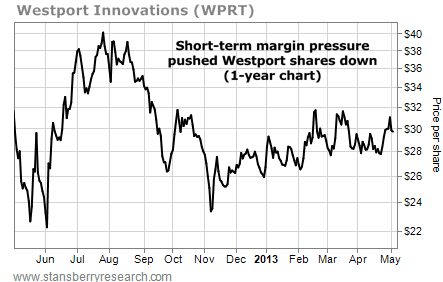 But the demand the company will see for its natural gas engines in the years ahead is too large to ignore. I suggest scaling in to Westport today. That means take a small position now… and build up a full position over time. Another
major winner of the natural gas boom is Chart Industries (GTLS).
Regular readers should be familiar with this name, too… The company is
one of the top suppliers of liquefied natural gas (LNG) fueling tanks in
the world.My subscribers are up over 40% since I recommended Chart Industries in early 2012. And the stock just broke out to an all-time high. But there is much more upside ahead. 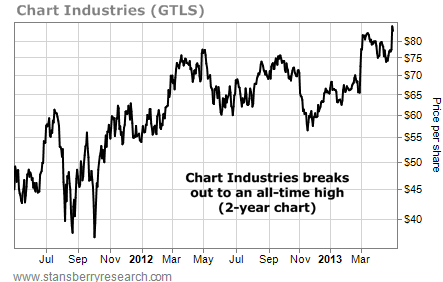 As I explained above, more and more fleets in the U.S. are switching to natural gas. That means more fueling stations will be built using tanks supplied by the company. Over the past few weeks, two major research firms upgraded Chart Industries. They see huge demand ahead for its LNG storage tanks not just in the U.S., but in China and Europe as well. I suggest buying Chart Industries on any weakness – and holding for the long run. – Frank Curzio |
|
Subscribe to:
Posts (Atom)