Read This Blog in 9 Different Languages

Wednesday, March 28, 2012

Will the College Bubble Wreck America? The Great Student Loan Debt Default

Whiskey & Gunpowder
by Mac Slavo

March 28, 2012
The Great Student Loan Debt Default
Like the housing bubble, which was predicated on easy money and rising prices, student loan lending has increased to unprecedented levels over the last decade.
There is some $1 Trillion in outstanding student loan debt in the United States, the majority of it borrowed by individuals who were sold the idea that they could go to college, party with their buddies at fraternity and sorority houses for four years, get a piece of paper that says they've received higher education, and then land a job paying $100,000 a year right out of school.
Somewhere along the way, however, things changed. When these highly educated young adults finally received their degrees, it turned out that all of those hundred thousand dollar jobs they were promised were either exported to countries where laborers are paid a fraction of the cost to do the same work, or they simply evaporated as demand for goods and services in America and around the world collapsed.
With no jobs, no way to pay for their own livings expenses, and a mountain of debt an alarming 85% of 2011 college graduates were forced to move back in with mom and dad after they got out of school.
Now, though full-blown economic recovery is touted as being just around the corner, millions of debt laden graduates are still finding it difficult, if not impossible, to find any meaningful labor, especially the kind of labor that would make it possible for them to pay off those expensive loans.
In September of 2011 college loan default rates had approached 15%. Six months later, things have gotten much, much worse. According to the Federal Reserve, those rates are rising and fully 27% of all outstanding college loans are now 30 days or more past due:
"In other words at least $270 billion in student loans are no longer current. That this is happening with interest rates at record lows is quite stunning and a loud wake up call that it is not rates that determine affordability and sustainability: it is general economic conditions, deplorable as they may be, which have made the popping of the student loan bubble inevitable.
"It also means that if the rise in interest rate continues, then the student loan bubble will pop that much faster, and bring another $1 trillion in unintended consequences on the shoulders of the US taxpayer who once again will be left footing the bill.
"From Fitch:
"‘Fitch believes most student loan asset-backed securities (ABS) transactions remain well protected due to the government guarantee on Family Federal Education Program (FFELP) loans. The Federal Reserve Bank of New York recently reported that as many as 27% of all student loan borrowers are more than 30 days past due. Recent estimates mark outstanding student loans at $900 billion- $1 trillion. Fitch believes that the recent increase in past-due and defaulted student loans presents a risk to investors in private student loan ABS, but not those in ABS trusts backed by FFELP loans.
"Why is the bubble starting to pop now?
"‘Several macroeconomic factors are putting pressure on student loan borrowers. The main ones are unemployment and underemployment. The Bureau of Labor Statistics estimates the current unemployment rate for people 20 to 24 years old at nearly 14% and for those 25 to 34 years old, 8.7%. Underemployment is difficult to measure for these demographics, but it is likely having a negative impact.
"Actually, no: the unemployment for 18-24 year olds is 46%. Yup: 46%.
Source: Zero Hedge
One in four college graduates can't make good on their student loans. These are massive numbers, folks.
Those default rates have nowhere to go but up – and yes, we're going to refer to them as ‘default rates', because even though the borrowers have yet to technically default, the odds of those back payments ever being made are virtually nil. There are simply no jobs out there for college graduates, as evidenced by the 46% unemployment rate among that age group.
In October of 2010 we warned of the popping of the college loan bubble:
"For college grads, it gets even worse. Not only can they not find a job, but they are putting financial pressure on their parents, who will now have to continue providing a home, food, and utilities until such time that their boomerang kid can get some meaningful work and contribute financially to the household. On top of that, they are debt laden with an average debt of over $23,000 once they graduate college. Considering that up until the recession, the average graduate made just $30,000 per year in an entry level position, and the fact that those types of jobs are now few and far between, we can see the potential for a new round of debt-defaults in the near future.
"Can anyone say College Loan and Education Bubble?
"The theory of ‘biflation,' one that we have presented to our readers in the past, suggests that there is a possibility of price deflation in debt based assets such as homes, and price inflation in essential goods such as food and energy. We'd mark college education as a debt-based asset, because these days most students depend on loans to pay costly tuition fees.This, like home prices, is simply not sustainable.The very same bubble that was created by easy Fed lending policies has led to a similar situation in college education. As credit became loose, and everyone with a pulse applied for a college loan and got one, the price of college education rose sharply".
It's safe to say that we are now seeing the college education bubble collapse right before our eyes.
That $270 billion is only the beginning. Remember, there are simply no jobs out there to offset these loans, so we can fully expect that the majority of these college loans will never be repaid (at least not by those who borrowed the money). The borrowers simply have no means of repaying them.
This is yet another too-big-to-fail that will end up coming out of the pockets of the US taxpayer.
Regards,
Mac Slavo
SHTFplan.com

Friday, March 23, 2012

Paul Ryan's Budget Wipes Out Most Government Agencies, Leaves Tens of Millions Uninsured

Paul Ryan’s Budget Wipes Out Most Government Agencies, Leaves Tens of Millions Uninsured: 
 House Budget Committee Chairman Paul Ryan this week came up with a budget proposal that would give the very wealthy and big businesses trillions of dollars in tax cuts and subsidies but slash funding for programs that benefit the poor, the disabled, children, and the middle class. Ryan’s Path to Prosperity (for his campaign donors) would reduce revenues by $4.6 trillion through a series of tax cuts, including reducing the corporate rate from 35 percent to 25 percent and exempting corporations’ foreign profits from U.S. tax. That’s on top of the $5.4 trillion in revenue lost from making the Bush tax cuts permanent. As Ryan wants to give away free money to the super rich and increase defense spending by $228 billion over the next 10 years, he chooses to pay for it by cutting services and programs most Americans rely on. Under his plan, non-defense federal spending would be reduced to less than 4 percent of the gross domestic production, down from 12.5 percent in 2011.  Most of the federal government  except Social Security, health care, and defense would disappear by 2050, according to new analysis by the Center on Budget and Policy Priorities.
“That includes everything from veterans’ programs to medical and scientific research, highways, education, nearly all programs for low-income families and individuals other than Medicaid, national parks, border patrols, protection of food safety and the water supply, law enforcement and the like,” the CBPP said.

Take transportation cuts, for example. Ryan’s spending on transportation would be 26.1 percent lower in 2014 than it is today. If that cut was applied to air-traffic control programs, Third Way estimates that there would be 3,092 more flight cancellations and 68,683 delays a year. That would strand 151,503 more people at the gate and make 3.3 million more people late every year. Ryan’s plan would allocate $78 billion a year for infrastructure repairs and upgrades, a lot less than the $200-262 billion suggested by think thanks that have analyzed the nation’s crumbling infrastructure. According to the Government Accountability Office, one in four bridges in the U.S. is “either structurally deficient and in need of repair, or functionally obsolete and is not adequate for today's traffic.”

Ryan’s budget also targets the country’s most vulnerable – the poor and disabled. His plan would repeal the Affordable Health Care Act, which when the law goes into full effect in 2014 helps 32 million Americans afford health care who do not get it today. If the law is repealed, insurers can once again deny coverage to 17 million children with pre-existing conditions who are now insured because of the law. That’s not all the damage Ryan’s plan would do. By 2050, his budget would cut 75 percent of spending from current levels on Medicaid, the Children’s Health Insurance Program and subsidies for private insurance. This would directly affect the disabled and elderly who need help paying for nursing home care, for example. His plan would also turn over Medicaid to states, causing tens of millions of people to lose coverage. A similar proposal Ryan came up with last year would worsen the problem of the uninsured and lead states to drop 14-27 million people, according an estimate by the Urban Institute. Besides ending Medicaid as we know it, Ryan, just like last year, wants to turn Medicare into a voucher program that would eventually result in seniors paying as much as two thirds of their medical costs out of their own pockets.

And for federal employees – while their agencies are still in operation  – the Ryan budget proposes an unprecedented $368 billion in federal workforce cuts, including extending the current pay freeze for three more years, cutting federal pensions by $78 billion, and eliminating 10 percent of the federal workforce from agencies like the Social Security Administration and Environmental Protection Agency by 2015.

The House Budget Committee this week voted to advance Ryan’s budget with two right-wing lawmakers voting against it because it doesn’t cause enough damage. Ryan’s plan will now go before the full House for a vote.

AFGE Secures Over 100 Signatures for Panetta Letter: As of March 20, AFGE leaders and activists have garnered support from 114 House lawmakers to sign on to a letter that will be sent to Defense Secretary Leon Panetta asking him to lift the ill-conceived cap on the civilian workforce that forces managers to cut tens of thousands of federal jobs. The letter, sponsored by Rep. Maurice Hinchey from New York, points out how DoD’s so-called “Efficiency Initiative” caps the number of civilian employees at the 2010 levels and incentivizes managers to use contractors instead of civilian employees, even though privatization is more expensive or violates the law. The letter asks Panetta to manage the workforces – military, civilian, and contractors – from the total force perspective so sourcing decisions are based on the law, cost, policy and risk instead of arbitrary constraints. The letter also asks DoD to comply with the law that would reduce spending on service contracts to FY10 levels, thus making it much more difficult to substitute contractors for federal employees.      
The Senate version of the letter will be circulated.
AFGE Praises Office of Special Counsel for Protecting Whistleblowers: AFGE applauded the recent actions by the U.S. Office of Special Counsel (OSC) in its investigation that uncovered retaliation against whistleblowers at the Department of the Air Force facilities in Dover, Del. Four employees, including AFGE members, alerted management officials to the “improper handling, processing and transport of human remains of deceased personnel and military dependents” and were retaliated against for doing so. OSC recommended disciplinary action be taken against the supervisors responsible for violations of the law that protect federal employees who engage in whistleblowing or other protected activities.
“The courage, dedication and resolve of federal employees are remarkable. Even in the face of reprisal and retaliation by management officials, our civil servants did what was necessary to shed light on acts of misconduct occurring at their facility,” said AFGE President John Gage.
“OSC has come a long way since the days of Scott Bloch,” said AFGE Assistant General Counsel of Legislation J. Ward Morrow. “Under the leadership of Special Counsel Carolyn Lerner, the agency has made it a priority to protect the rights of whistleblowers. It’s important that we expand whistleblower protections in the federal sector to ensure that employees at any agency know they will be protected when revealing unjust and unlawful acts.”
Bill Introduced to Cap Contractor Compensation at $400,000: A bipartisan group of senators have introduced legislation that would sharply lower the compensation that all federal contractors can charge taxpayers. The Commonsense Contractor Compensation Act, S. 2198, would cap the reimbursement rate at the president’s salary, currently $400,000, and apply it to all contractor employees. Lowering the cap would not limit how much these contractor employees can earn, only how much of their compensation can be charged to the taxpayers. AFGE for years has been calling attention to runaway contractor payments. Government contractors in non-DoD agencies currently can charge taxpayers $693,951 a year for each of their five most highly paid executives, a benchmark that has more than doubled during the past 12 years. Other contractor employees are not subject to the cap and can earn far larger salaries that are subsidized by taxpayers.  In DoD, all contractor employees are held to the current ceiling of almost $700,000.  OMB is reportedly poised to raise the benchmark to $750,000.
“Current federal employees have had their own salaries frozen for two years and new employees will have to pay four times as much in retirement contributions, saving the government $75 billion. Yet nothing is being done to trim out-of-control contractor spending,” AFGE President John Gage said. “Taxpayers should not be on the hook for these outrageous salaries that no one in government earns – not federal employees, not members of Congress and not even the President of the United States.”
The bill was introduced by Sens. Barbara Boxer of California and Charles Grassley of Iowa. A similar bill introduced in the House by Rep. Paul Tonko of New York would lower the cap to $200,000 and apply it to all contractors.
McCaskill Declares She Will Not Support BRAC: Sen. Claire McCaskill, chairman of the Senate Armed Services Readiness and Management Support subcommiteee, announced Wednesday that she will not allow another round of base realignment and closure commission (BRAC) proposed by the administration.
“I will not support the request for a BRAC process to be carried out in 2013,” McCaskill said during a hearing before her subcommittee on the plan. “The impact BRAC has on our communities around the country, such as those surrounding my home state bases Fort Leonard Wood and Whiteman Air Force Base, is extraordinary. I will not support a process that is callous or casual, or one that is rushed before we fully comprehend whether the traumatic task is clearly in the best interests of the American taxpayer and our national security.”
AFGE Participates in Selma March Anniversary: Forty-seven years after the 1965 Selma March that fought for voting rights and equality, civil rights leaders, labor activists and minorities re-convened to participate in the anniversary of the historic march. Led by Reverend Al Sharpton, thousands of activists including AFGE leaders marched to rally against new voting laws passed in several states and anti-immigration laws passed in Alabama. AFGE National Secretary Treasurer J. David Cox, National Vice President for District 5 Everette Kelley and National Vice President for District 12 Eugene Hudson were just a few AFGE representatives who participated in the historic march.
Voter protection continues to be at risk and AFGE is dedicated to preserving the rights of American voters. Different states have different laws on what proper identification is needed at the polls. It varies from something simple as a signature verification to bringing in an utility bill. For information on what your state requires, up-to-date local news that may affect you, and polling locations visit www.electionprotection.com or call 1-800-OUR-VOTE (687-8683).

This Week in Labor History: On March 25, 1911, 146 workers were killed in a fire at New York’s Triangle Shirtwaist Factory, a disaster that would launch a national movement for safer working conditions.

So You Think You Can Dance? This two-year-old boy thinks he can.

Inside Government: Tune in now to AFGE’s "Inside Government" to learn about the union’s fight against privatization. The show, which originally aired on Friday, March 16, is now available on demand. AFGE Council of Prison Locals President Dale Deshotel and AFGE Transportation Security Administration Local 1120 Montana Vice President Eric Wood detailed the challenges privatization efforts present to federal workers. Deshotel also discussed funding and staffing issues at the Bureau of Prisons while Wood addressed the union’s work to negotiate a contract for Transportation Security Officers. But first, Food & Water Watch Senior Lobbyist Tony Corbo continued last week’s discussion about ongoing concerns with the USDA’s Food Safety and Inspection Service proposal to partially privatize poultry inspections. Lastly, AFGE Department of Defense Local 2142 President Joe Gonzales discussed his local’s efforts to improve workplace conditions and employee morale.

Listen LIVE on Fridays at 10 a.m. on 1500 AM WFED in the D.C. area or online at www.federalnewsradio.com.


American Federation of Government Employees, AFL-CIO 80 F Street, N.W., Washington, D.C. 20001 | Tel. (202) 737-8700 | Fax (202) 639-6492 | www.afge.org

Tuesday, March 20, 2012

House Republicans released their budget, known as The Ryan Plan. And it is a disaster for the middle class !

Just this morning, House Republicans released their budget, known as The Ryan Plan. And it is a disaster.

Named after House Budget Committee Chairman Paul Ryan, the GOP's "1%-First" budget attacks the federal workforce with cuts to pensions, pay freezes, and job cuts. In fact, it targets the entire middle class: It would destroy Medicare as we know it, ship jobs overseas, and force the Department of Veterans Affairs, the Department of Homeland Security, and other agencies to slash the services that families rely on... all in order to provide tax cuts for the wealthy and corporations.

Now here's the good news: Some pundits are already declaring this budget a major political error for the GOP. They're right. Americans hated last year's budget, and they'll hate this far more radical and anti-middle class sequel that much more. But it's up to us to prove it before the House marches forward.

Phones ringing off the hook will show the House GOP that the backlash has already started – can you help? Call your Representative at 1-866-220-0044 right now and tell them you reject the GOP budget.

Don't stay silent if you've got a Democratic representative, either. The big-bailout banks and deep-pocket donors on Wall Street will be twisting arms. Every single member of Congress needs to hear from you. Here's how:

* Call the Congressional Switchboard at 1-866-220-0044.
* Ask for your Representative in the House.
* Tell the staffer who answers that the Ryan Plan is budget anarchy that doesn't represent your values as an American and, as a constituent, you won't support anyone who votes for it.

The Ryan Budget proposes an unprecedented $368 billion in federal workforce cuts, including extending the current pay freeze for three more years, cutting federal pensions by $78 billion, and eliminating 10% of the federal workforce from agencies like the Social Security Administration and Environmental Protection Agency. And it will make the wealthy even more so by eliminating the Alternative Minimum Tax and lowering the corporate tax rate to 25% from 35%, half that of Reagan-era rates.

This budget is not who we are as a country. It's bad politics and even worse government. Americans care about our veterans, our children, and our elderly. We want our food and water to be clean, and our communities safe. The Ryan Plan ignores all of these values in order to deliver 10% tax breaks to the Wall Street millionaires and billionaires who line the pockets of Republican leaders.

It was only released today, so there's no better time to make sure your voice is heard. We've had some important victories this year, but this may turn out to be the most important fight yet.

In solidarity,

John Gage
AFGE National President

P.S. If you call and the phone lines are busy, call back. If you get this when your representative's office has already closed for the day, leave a message – then call back the next morning. This is the moment to pour the pressure on.

For the latest updates on your pension, pay, budget cuts, and other news, text "NoCuts" on your personal phone to 225-568 or sign up online.
URGENT: GOP Budget Released Today

Cuts in pension, pay, jobs proposed in order to lower taxes for corporations and the wealthy. Call Your Representative NOW: 1-866-220-0044

Wednesday, February 29, 2012

Get Firesale Free Highly-Targeted Web Traffic Mogul System Plus Over 25 Bonuses Before March 8, 2012 for $40 LESS

Click to see Video: 10 Day Firesale: Grab Traffic Mogul System for Free Web Traffic and Windfalls of Cash!
Grab My System for Free Web Traffic and Windfalls of Cash!

(ENDING ON March 8,2012 ----!)


You will have instant access to download the files.

Click the order button to grab it now:


If you need assistance, please contact us at willswebservice@comcast.net--

To your success,

---William H. Stewart---

This offer will be taken down at the

end of ----March 8 ,2012----!

BONUSES: 1. Free Traffic Mogul (Software & 2 ebooks)

2. Domain Backlinker Software

3. Domain Estimator Software

4. FTM Squeeze Generator Software

5. 18 Free Traffic Mogul Videos

6. Bonus Ebook: 100 Fast Cash Methods

7. Surprise Bonus Software: Backlinks Inspector


10 Free eBooks: 1) Residual Income Streams, 2) 8,605 Words & Phrases That Sell , 3) How To Sell Web Hosting ,4) Website Conversion , 5) Get Paid to Shop , 6) Inside The Minds of winners , 7) eBay Cash! , 8) Building A Virtual Corporation , 9) How to Build HTML , 10) Google Back Door , XTRA: The Writing Cash Program

10 More Free eBooks: SEO Made Easy, Adwords Made Easy, Dotcomology, Free Critical List Building Report, Smart & Safe Backlink Building Guide, Affiliate Money Machine,
The Big Book of Proof, Backlinks Stop Wasting Your Time, Powerful Promotion through Video Marketing, Harness the Power of Article Marketing

How To Rank Number 1 in Google in Less Than a Day, VideoSales Letter Formula and 5 other MIND-NUMBING SECRET eBooks !

Click the order button to grab it now:


Copyright 2012 - All rights reserved.

Thursday, February 16, 2012

If history doesn’t repeat, but rather rhymes, as Mark Twain said... then we recognize some doggerel this morning in the latest news from the Persian Gulf.

“Iran has been systematically plundering large amounts of oil from southern Iraq for years,” according to a UPI story that cites a report from Stratfor, the U.S.-based private intelligence outfit.

Through a “complex oil smuggling network,” the Islamic Republic is able to pull in $20 million per day in oil revenue that short-circuits Western sanctions, the report claims.

If there’s something about this that sounds familiar, recall one of Saddam Hussein’s justifications for Iraq’s invasion of Kuwait in 1990 was Kuwait was stealing Iraq’s oil. The Kuwaitis, he said, resorted to “slant drilling,” whereby its wells entered the earth on Kuwaiti territory, but crossed the border underground.

“There’s an element of Iraqi propaganda here,” observes our Byron King — who takes note of every development that hinges on his New War scenario — “but I don’t doubt that Iran is somehow sucking Iraqi oil into is pipeline system.”

“I just saw another report,” says Vancouver favorite Doug Casey, “proclaiming that Iran is likely to attack the U.S., which is about as absurd as the allegations Bush made about Iraq bombing the U.S., when he fomented that invasion.”

Hmmm... Another rhyme.

“It’s starting to look rather serious at this point,” Mr. Casey continues, “so I do think the odds favor actual fighting in the not-too-distant future. We’re dealing with criminal personalities on both sides, and criminals are basically very stupid — meaning they have an unwitting tendency to self-destruction.”

Doug’s investment guidance for this scenario is similar to his guidance for other man-made disasters: gold and silver to safeguard your wealth, gold stocks if you’re feeling speculative. “And diversify your holdings internationally. You can never tell when the government of your home country will have a psychotic break.”

Aside from spelling out a war scenario, Byron King’s New War report also presents an investment strategy to help you protect and grow your portfolio during the tumult — starting with three market moves you can make right away. Here’s where to get started.

Wednesday, February 8, 2012

How to Get Rich in 2012 Starting with Zero Cash

How to Get Rich in 2012

There's a practically 'forbidden' investment that could make you a boatload of cash in the coming year. In fact, it's not uncommon to see triple-digit gains in a single day with these investments. Yet few people know how to access them or that they even exist. Although this opportunity isn't for everyone – those who take advantage of it could make an absolute killing in 2012.

Click here to watch this 'how to' video
.
---------------------------------

It's Not Too Late to Get Into This Huge 2012 Trade in Resource Stocks

By Matt Badiali, editor, S&A Resource Report
Wednesday, February 8, 2012
It's not too late… but if you want to get on-board one of biggest money-making trades of 2012, you need to act soon.

If you don't take action, you could miss out on 50%-100% gains this year.

Over the past three months or so, my colleague Steve Sjuggerud and I have been writing about the "bad to less bad" opportunity setting up in natural resource stocks… the companies that mine things like copper, fertilizer, gold, silver, coal, and iron ore.

Regular DailyWealth readers know this sector of the market is capable of experiencing huge booms and busts. Stay out of the busts, get in early on the booms, and you can easily make 50%-100% in a year with these companies.

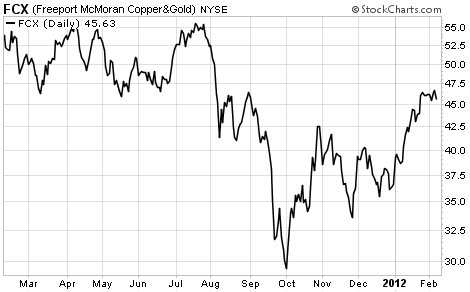
As I highlighted last month, resource stocks busted in 2011. They had enjoyed a big run higher in 2010. But when folks got scared of holding stocks and commodities last year (due to fears of the European debt crisis and the ripple effects it would have on the rest of the world), they dumped resource stocks… Major "trophy" stocks like Freeport-McMoRan (copper) and Vale (iron ore) lost 30%-50% of their values in just months. Smaller resource stocks lost even more.

As Steve and I expected, resource stocks have put in a bottom… and have staged a big rally. For example, Freeport is up 26% since Steve ran this essay.


While resource stocks are likely to take a short-term breather after this big surge, there's good reason to expect them to keep rising over the course of 2012.

As my colleague Porter Stansberry recently noted, Europe is now printing money in order to stave off its debt crisis. The U.S. Federal Reserve has an ultra-stimulative interest rate policy in place right now. These efforts should "goose" the economy… which will drive up the prices of natural resources. That's a big tailwind for companies like Freeport.

Since Freeport and its sector colleagues have climbed so much in such a short time, it's only reasonable to expect a small correction. That's just how the market works. When that correction arrives, use it as a buying opportunity… and let the coming natural resource "boom" do the rest.

Good investing,

Matt Badiali
Further Reading:

In addition to Freeport and Vale, Matt believes two other resource stocks are headed higher. "These are among the world's greatest 'boom and bust' sectors," he writes. And shares "have the potential to rally 50% or 100% in the coming year." Read more here: How to Risk a Little and Potentially Win A LOT in the Reso
urce Market.